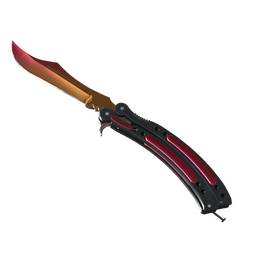
Case Hardened Blue Gems and Fade Percentages in CS2
How paint seeds decide Case Hardened blue coverage and Fade percentages, why one skin can sell at wildly different prices, and how to verify a pattern.

Most CS2 skins are priced by name, exterior and float. A handful are priced by pattern, and for those the name is only the starting point. Two Field-Tested AK-47 | Case Hardened rifles can look completely different, and the difference can be worth more than the rest of a player's inventory.
Paint seeds: the number behind the pattern
When a skin is created, it gets a float (how worn it looks) and a paint seed, shown in the in-game inspect panel as the Pattern Template. The seed is a whole number from 0 to 1000, so every finish has 1,001 possible patterns. It decides how the texture is positioned on the weapon model: which part of the artwork lands on the slide, the magazine or the blade.
For most skins, the seed changes little. You might see a slightly different crop of the same design. For a few finishes, the seed changes the colours you actually see, and that is where pattern premiums come from.
Since Valve's May 2026 overhaul of the Steam Community Market, CS2 listings there show the pattern template alongside the float. Most third-party marketplaces have shown it for years.
Case Hardened and blue gems
How the finish works
Case Hardened imitates heat-treated metal: a mix of gold, blue and purple patches over steel. It appears on the AK-47, Five-SeveN and MAC-10, on many knives and on Hydra Gloves. The seed decides how much of each colour lands where.
Most patterns are a mix. A small number put a large share of blue on the visible side of the item, and those are the blue gems. Traders grade them by how much blue shows on the play side (the side you see in first person), how much on the back, and how clean the blue is.
Seeds are model-specific
A blue seed on one weapon is not blue on another, because the texture maps differently onto each model. The AK-47's most famous blue gem is pattern 661, but that number means nothing for a Karambit or a Five-SeveN. Each model has its own short list of top seeds, and collectors track them separately.
What the public price tells you
As of October 14, 2026, cs2skins.gg showed these cheapest AK-47 Case Hardened listings:
| Exterior | Cheapest listing |
|---|---|
| Factory New | $381.40 |
| Minimal Wear | $228.98 |
| Field-Tested | $187.61 |
| Well-Worn | $153.63 |
| Battle-Scarred | $157.82 |
Those are floor prices for ordinary patterns. Top-tier blue gems rarely appear in public listings at all. They change hands privately, often through brokers, and their prices don't show up in listing data. Mid-tier patterns with partial blue sit in between, and that is where most of the pattern market's day-to-day trading happens.
The Case Hardened family page lists every item with the finish, which is useful for comparing floors across models.
Fade and fade percentages
How the finish works
Fade is a gradient that runs from yellow through pink to purple and blue. It appears on many knives and on guns such as the Glock-18 | Fade. The seed decides where the gradient sits on the model, which changes how much of the purple and blue end is visible.
What a fade percentage is
Traders describe Fades with a percentage, such as an "80% fade" or a "100% fade". Higher numbers mean more of the gradient is visible, ending in deep purple at the tip. Valve does not publish these percentages. They come from third-party tools that map seeds to a score, and different tools use different methods, so the same knife can carry slightly different numbers depending on where you look.
Treat a fade percentage as a description, not a measurement. What sells the knife is how it looks on the play side.
Prices as of October 14, 2026
The cheapest Factory New Karambit | Fade on cs2skins.gg was $1,525.55, and the cheapest Minimal Wear copy was $1,296.00. Like Doppler, Fade knives have a 0.00–0.08 float range, so Minimal Wear is a thin slice. The floor is a low-percentage Fade. High-percentage copies sell above it, sometimes far above, and those sales are negotiated individually.
Marble Fade and other pattern finishes
Marble Fade, a different finish, has its own pattern market. The best-known category is "Fire and Ice", where only red and blue appear on the blade. Several other finishes, including Crimson Web, where web placement matters, also carry pattern premiums. The Fade family page covers the classic gradient across all models.
How pattern premiums get priced
Pattern items have two prices: the floor for the name and exterior, and a premium for the specific pattern. The floor is easy to look up. The premium is not, for three reasons:
- Few comparable sales. Each top pattern is close to unique, so there may be no recent sale of the same seed on the same model.
- Thin buyer pool. Only a small group of collectors pays large premiums, and their demand changes quickly.
- Private deals. Big sales often happen outside public marketplaces, so asking prices are easier to find than sale prices.
That makes pattern items slow to sell at full value. If you need liquidity, sell near the floor. If you can wait, list with a premium and expect to be patient.
Verifying a pattern before you pay
- Read the seed yourself. Inspect the item in game or on its listing, and confirm the pattern template matches the claim.
- Look at both sides. Blue gems are graded on the play side and the back. Ask for or generate screenshots of each.
- Use the right model. Confirm the seed against data for that exact weapon, not a different knife or gun.
- Distrust borrowed screenshots. A screenshot can show another item with the same name. The seed, float and inspect data on the actual listing are what count.
- Check the confirmation screen. In a direct trade, swapping a cheap pattern for an expensive one at the last step is a classic scam.
Risks to keep in mind
Pattern premiums depend on collector taste, and taste shifts. Grading standards change as the community re-evaluates seeds, and any future rendering update could change how patterns look. Selling also takes longer than for ordinary skins. Buy a pattern because you like it, and check the floor across stores on the marketplace comparison page so you know how much of the price is premium.